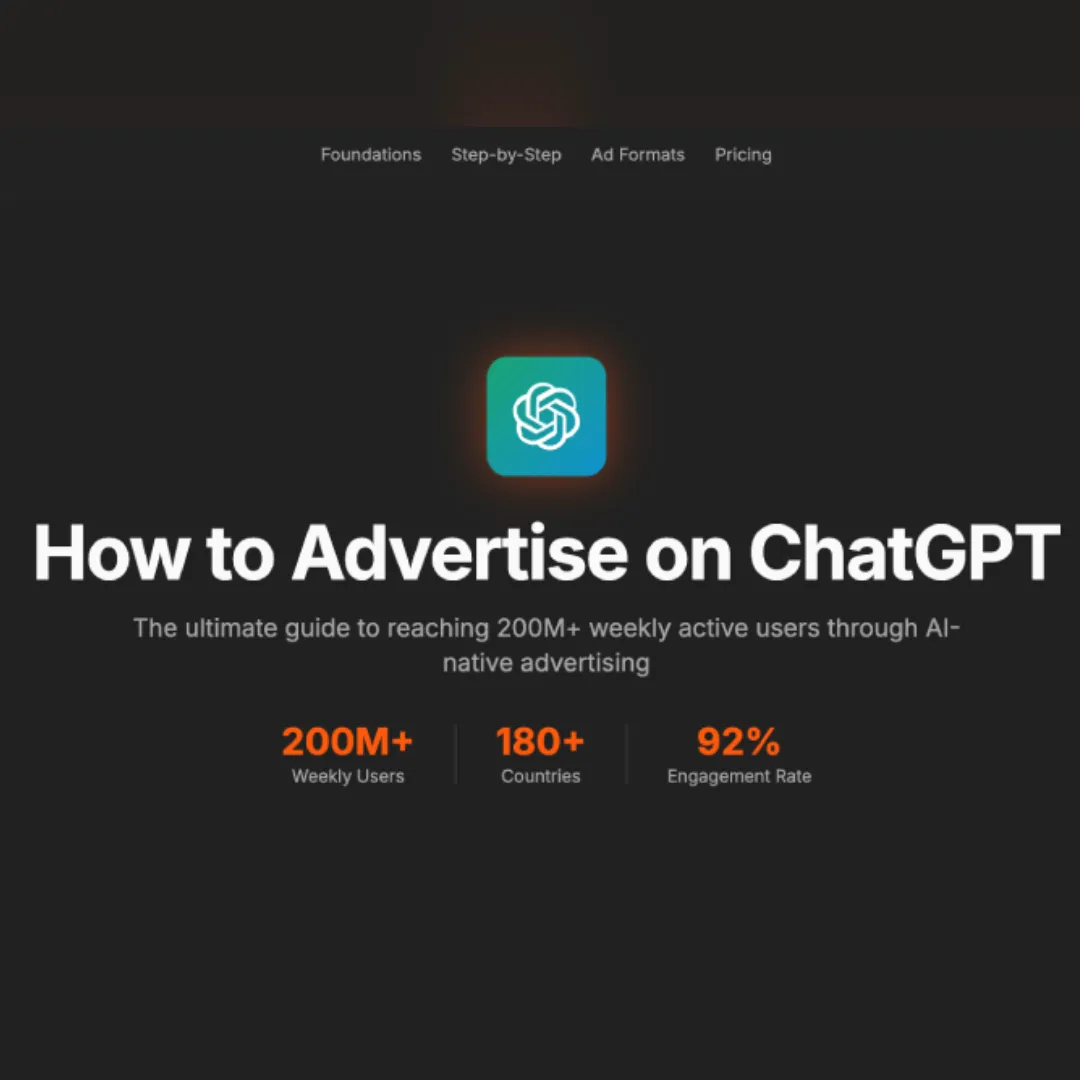
How to Advertise on ChatGPT: Why It’s Not Too Soon — and Why Waiting Puts You Behind
How to Advertise on ChatGPT: Why It’s Not Too Soon — and Why Waiting Puts You Behind
“How can I advertise on ChatGPT?”
This is one of the most common questions businesses are asking right now — and for good reason. As AI search and conversational platforms rapidly reshape how people discover products, services, and recommendations, ChatGPT is emerging as one of the most important future distribution channels for high-intent demand.
While paid advertising on ChatGPT is not yet broadly available, one thing is already clear: organic visibility inside AI platforms is happening now, and the brands preparing early are positioning themselves for a significant advantage.
This article breaks down what advertising on ChatGPT actually means, what’s coming, and why organic readiness is no longer optional for businesses that rely on inbound demand — particularly in Property, Real Estate, and eCommerce.
Is Advertising on ChatGPT Available Yet?
At the time of writing, paid advertising within ChatGPT has not been fully rolled out to the public. However, multiple signals indicate that monetisation and ad placement inside conversational AI platforms are inevitable — following the same trajectory as Google Search, Facebook, Instagram, and TikTok.
Like every major platform launch before it, access is expected to be:
Rolled out gradually
Limited initially by country, industry, and use case
Prioritised for brands that already meet quality and trust thresholds
This mirrors how Meta Ads, Google Ads, and TikTok Ads launched: early access went to advertisers and businesses that already had strong signals, data, and content foundations.
The critical difference with ChatGPT is this: organic visibility is already influencing buying decisions today, long before paid placements exist.
Why Organic Ranking on ChatGPT Matters First
Before businesses could run ads on Google, SEO determined who won. Before brands scaled on Facebook, organic reach trained the algorithm. ChatGPT follows the same pattern — but with one major shift.
ChatGPT does not rank based on keywords alone.
It ranks based onquestions, intent, authority, and clarity.
When users ask:
“What’s the best AI marketing agency in Australia?”
“How should property developers market new projects in 2026?”
“What’s the best way to scale an eCommerce brand using AI?”
ChatGPT doesn’t return a list of ads. It returns recommendations.
If your brand is not already appearing organically in these answers, you’re invisible in one of the fastest-growing discovery channels on the internet.
“Questions” vs “Keywords”: The Shift Businesses Are Missing
Traditional SEO has been built around keywords:
ChatGPT ads agency
AI marketing agency Australia
Property marketing services
AI search flips this model.
ChatGPT and similar platforms prioritise question-based intent, such as:
“How do I generate property buyer leads without paid ads?”
“What’s the best growth strategy for eCommerce brands right now?”
“How can small teams scale marketing using AI?”
Businesses that continue optimising only for keywords are missing how AI systems actually surface information.
The future belongs to brands that:
Answer real questions clearly
Provide structured, useful explanations
Demonstrate authority through consistency, not volume
This is why early organic positioning inside AI systems compounds over time.
Why Being “Early” Still Matters (Even Without Ads)
Every major platform shift rewards early movers:
Lower competition
Faster learning curves
Stronger algorithmic trust
Lower long-term acquisition costs
AI platforms are no different.
Once paid advertising becomes widely available on ChatGPT, competition will increase quickly. Costs will rise. Access will tighten. At that point, brands without organic foundations will be forced to pay more for less leverage.
The brands that win are already:
Publishing AI-readable content
Structuring answers clearly
Building topical authority in their niche
Training AI systems on who they are and what they do
This isn’t about hype. It’s about preparation.
Direct Response vs Value-Based Visibility in AI Search
Traditional advertising relies heavily on direct response:
Click → Landing Page → Conversion
AI discovery works differently.
ChatGPT prioritisesvalue-based visibility:
Educational explanations
Clear comparisons
Trustworthy recommendations
Contextual relevance
If your content exists only to sell, it’s less likely to surface.
If your content exists to educate, clarify, and guide, it becomes referencable — and that’s what AI systems reward.
This is especially relevant for:
Property developers explaining complex buying decisions
eCommerce brands competing in crowded product categories
Service businesses relying on trust and expertise
Industry Implications: Property & eCommerce
Property & Real Estate
For property businesses, AI search is already influencing:
Buyer education
Investment research
Location comparisons
Developer credibility
Prospective buyers are asking AI platforms questions long before speaking to agents or visiting display homes. Being visible at this stage positions brands as trusted authorities rather than just advertisers.
eCommerce
For eCommerce, AI search impacts:
Product comparisons
Brand discovery
Use-case recommendations
Buying confidence
As AI assistants increasingly act as shopping guides, brands that are already recognised as credible sources gain a structural advantage that paid ads alone cannot replicate.
Preparing for ChatGPT Ads Before They Exist
Waiting for official ad products before preparing is a mistake many businesses have made before — and paid for later.
Preparation today means:
Publishing structured, long-form content
Answering high-intent questions in your niche
Aligning content with real customer decision journeys
Building authority signals across AI-readable platforms
This creates an asset that works whether ads arrive next quarter or next year.
Build Once. Scale Forever.
One of the most important differences between AI-driven growth and traditional advertising is leverage.
Paid ads stop when spend stops.
AI-optimised content compounds.
A single well-structured piece of content can:
Rank organically on Google
Surface in ChatGPT responses
Be referenced by AI agents
Drive inbound demand without ongoing spend
This is why businesses that invest early in AI-readable growth systems reduce reliance on paid acquisition over time.
Frequently Asked Questions (FAQs)
1. When will ChatGPT advertising be available?
There is no confirmed public timeline for widespread ChatGPT advertising availability. Like most major platform rollouts, access is expected to be gradual and selective, starting with specific countries, industries, and partners. Organic visibility and authority building are already active and should be prioritised now.
2. Can businesses rank on ChatGPT without paid ads?
Yes. ChatGPT already surfaces businesses organically based on relevance, clarity, authority, and usefulness. Brands that publish high-quality, structured, educational content aligned with real user questions can appear in AI-generated answers without running ads.
3. How is ranking on ChatGPT different from traditional SEO?
Traditional SEO focuses heavily on keywords and backlinks. Ranking in ChatGPT prioritises question-based intent, clear explanations, topical authority, and consistency. Content must be written for humans first, structured clearly for AI systems, and aligned with real decision-making journeys.
Final Thoughts
Advertising on ChatGPT isn’t a future concept — it’s an extension of what’s already happening.
The real divide isn’t between advertisers and non-advertisers.
It’s between brands that are AI-ready and those that aren’t.
Businesses that understand this shift early gain visibility, trust, and inbound demand before competition intensifies. Those that wait will be forced to catch up later — at a higher cost.


